How to Read a Nigerian Property Listing: What the Price Does Not Tell You
The headline price on a Nigerian property listing is never the full cost. This guide breaks down every hidden fee — agent fees, stamp…
Every day, thousands of Nigerians browse property listings — on PropertyPro, on WhatsApp groups, on estate agent Instagram pages — and make decisions based almost entirely on the headline price. A three-bedroom flat in Lekki for ₦35 million. A plot of land in Ibeju-Lekki for ₦8 million. A self-contained apartment in Yaba for ₦1.2 million per year.
Those numbers feel concrete. They feel comparable. They feel like the starting point for a decision.
They are not.
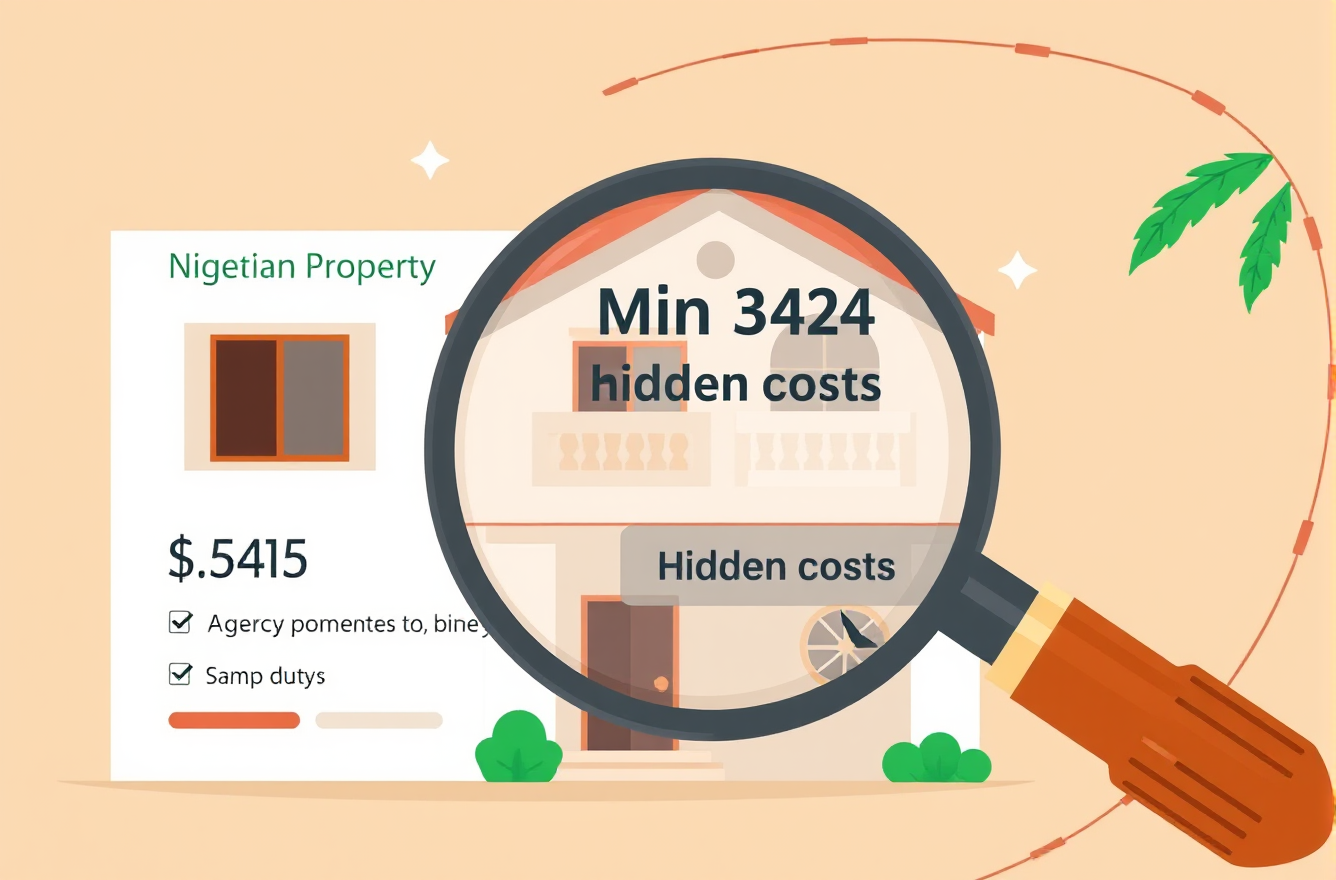
The headline price on a Nigerian property listing is never the full cost. It is not even close. Between what you see in the listing and what you actually pay, there are fees, charges, verification costs, hidden expenses, and structural realities that can add 15–30% or more to your total outlay. And if you are comparing two properties at the same headline price, those hidden costs can make one dramatically more expensive than the other.
This guide breaks down every cost layer in a Nigerian property transaction — so you can compare listings accurately, budget realistically, and avoid surprises that derail your purchase.
Layer 1: The Headline Price (What You See)
The headline price is the number in the listing. It is what the seller or agent advertises. It may be accurate, inflated, or negotiable — but it is only the starting point.
What the headline price does not include:
- Agent fees
- Legal fees
- Stamp duties
- Survey costs
- Development levies
- Renovation or furnishing costs
- Verification expenses
Two properties listed at ₦30 million can have total acquisition costs of ₦33 million and ₦39 million respectively, depending on these additional layers.
Layer 2: Agency and Legal Fees
In Nigeria, the buyer typically pays both the buying agent’s fee and the legal fees for documentation. Here is what to expect:
- Agent fee: 5–10% of the purchase price, depending on the location and the agent. In Lagos, 5% is standard for established agents; in some emerging areas, agents may charge up to 10%. Some listings include the agent fee in the headline price, but many do not.
- Legal fee: 2–5% of the purchase price for property documentation, agreement drafting, and title verification. Quality legal work is not where you cut costs — a poorly drafted agreement or an unverified title can cost you far more than the legal fee.
- Agreement fee: In some markets, particularly for rental transactions, you may encounter a separate agreement fee. This should be confirmed upfront.
On a ₦30 million purchase, agency and legal fees alone can add ₦2.1–₦4.5 million. For a detailed breakdown of agency fees across Nigerian states, see the Lagos Tenancy Bill 2026 guide.
Layer 3: Stamp Duties and Government Charges
Stamp duties and registration fees are legally required and non-negotiable (source: KeepAm — Stamp Duty in Nigeria 2026):
- Stamp duty: Typically 1.5% of the purchase price for properties above ₦10 million, payable to the state government. This rate varies by state — Lagos charges differently from Ogun, which charges differently from Abuja.
- Registration fee: Varies by state, typically around 1% of property value.
- Consent fee: Some states charge a governor’s consent fee on property transfers. In Lagos, this is around 1.5% of property value.
- Capital gains tax: 10% of the gain on the property, typically paid by the seller, but in practice, the cost is sometimes passed to the buyer in one form or another.
These are not optional. They are legal requirements, and failure to pay them can create title problems later. On a ₦30 million property, budget roughly ₦1.2–₦1.5 million for stamp duties and government charges.
Layer 4: Survey and Verification Costs
Before you pay for any property, you need to verify title. This is not a formality — it is the most important step in the entire transaction.
- Search at the land registry: ₦50,000–₦150,000 depending on the state and the complexity of the title history.
- Survey plan: If the property does not have an up-to-date survey plan, you will need one. Cost: ₦150,000–₦500,000 depending on location and property size.
- Title verification through a lawyer: Legal due diligence on title, encumbrances, and disputes typically costs ₦200,000–₦500,000. This is separate from the legal fee for documentation.
Budget ₦400,000–₦1.15 million for survey and verification, depending on property value and location.
This step is not negotiable. Fake land sales, disputed titles, and encumbered properties are the most common way buyers lose money in Nigerian real estate.
Layer 5: Development and Infrastructure Levies
If you are buying into an estate or a developed community, there are often additional charges:
- Development levy: A one-time charge for estate infrastructure (roads, drainage, street lighting, perimeter fencing). This can range from ₦500,000 to ₦5 million or more, depending on the estate.
- Service charge: Ongoing monthly or annual fees for estate maintenance, security, and shared services. For luxury estates, this can be ₦100,000–₦500,000 per month.
- Infrastructure fee: Some estates charge separately for electricity connection, water treatment, and waste management infrastructure.
Always ask for a complete fee schedule before committing. These charges are sometimes disclosed late in the process, after you have already made a deposit.
Read Next
 Mini Flat for Rent in Ajah — Complete Price Guide (June 2026)
Layer 6: Renovation and Furnishing
If you are buying a completed property, it rarely comes in move-in condition without additional spending:
- Renovation: Budget 5–15% of the purchase price for renovations, depending on the property’s condition. Even “newly renovated” properties often need work.
- Furnishing: If you are buying for rental yield, furnished properties command significantly higher rents. Furnishing a three-bedroom flat in Lagos typically costs ₦3–₦8 million, depending on quality.
- Appliances and fittings: Air conditioning, water heaters, kitchen fittings, and wardrobes may not be included in the headline price.
Layer 7: Financing Costs (If You Are Using a Mortgage)
If you are financing through MREIF or a commercial bank, additional costs apply (see: How to Buy Your First Home in Nigeria with Only 10% Down Payment):
- Down payment: 10% (MREIF) to 20–30% (commercial banks) of the purchase price.
- Mortgage processing fee: 1–3% of the loan amount.
- Insurance: Mortgage insurance and property insurance are typically required.
- Valuation fee: Banks require an independent property valuation before approving a mortgage. Cost: ₦100,000–₦300,000.
See: How to Buy Your First Home in Nigeria with Only 10% Down Payment (MREIF Guide)
The Complete Cost Breakdown: A Real Example
Let us walk through a realistic example. You see a listing for a three-bedroom flat in Lekki Phase 1 at ₦45 million. Here is what the actual cost looks like:
| Cost Item | Amount |
|---|---|
| Headline price | ₦45,000,000 |
| Agent fee (5%) | ₦2,250,000 |
| Legal fee (3%) | ₦1,350,000 |
| Stamp duty (1.5%) | ₦675,000 |
| Registration fee (1%) | ₦450,000 |
| Survey and verification | ₦800,000 |
| Development levy (estate) | ₦2,000,000 |
| Renovation (8%) | ₦3,600,000 |
| Total actual cost | ₦56,125,000 |
That is ₦11.1 million — nearly 25% — above the headline price.
Now compare that to a similar three-bedroom flat in Ajah listed at ₦28 million. If the additional costs are similar in percentage terms, the total might be ₦34.9 million. The difference between the two is not ₦17 million — it is closer to ₦21 million when you include all acquisition costs.
This is why comparing listings by headline price alone is misleading. You must compare by total acquisition cost.
How to Use This Guide When Browsing PropertyPro
When you see a listing that interests you, add these layers before making a decision:
- Add 15–30% to the headline price for all acquisition costs.
- Verify title before making any payment — this is the single most important step.
- Ask for a complete fee schedule from the estate or developer, including all levies and service charges.
- Compare total cost across neighbourhoods using the same budget. A ₦30 million budget in Lekki Phase 1 buys something very different from the same total budget in Ajah, Ibeju-Lekki, or Ogun — and that is before you factor in commute costs, infrastructure quality, and lifestyle differences.
- Use PropertyPro’s filters to compare the same budget across multiple locations.
Start comparing: Property for sale in Nigeria | Property for rent in Nigeria
What Renters Need to Know
The hidden-cost problem is not limited to buyers. Renters face a similar dynamic:
- Agency fee: Typically 5–10% of the annual rent for the first year.
- Legal fee: 5–10% of the annual rent (sometimes combined with the agency fee).
- Caution deposit: Usually 10–20% of annual rent, refundable at the end of the tenancy if the property is returned in good condition.
- Service charge: For estates and serviced apartments, this can be ₦50,000–₦300,000 per month.
- Renovation expectations: Some landlords expect tenants to paint, fix, or upgrade the property before moving in. Clarify this before signing.
On a ₦2.4 million annual rent (see the Lagos Tenancy Bill 2026 guide for a detailed breakdown) (₦200,000/month), first-year costs can total ₦3.6–₦4.2 million when you include agency, legal, and deposit costs.
See: Lagos Tenancy Bill 2026: What Renters, Landlords, and Property Investors Need to Know
FAQ
Can I negotiate the headline price down to offset some of these costs?
Yes, and you should. Most Nigerian property prices are negotiable. The key is to negotiate based on your total cost budget, not just the headline price. If your total budget is ₦50 million, and the additional costs on a ₦45 million listing are ₦11 million, you need to negotiate the price down to ₦39 million or less — or find a different property.
Are development levies always charged?
Not always, but they are common in estates and organised developments. Always ask for a complete fee schedule upfront. If a developer cannot provide one, that is a red flag.
What is the single most important cost to verify?
Title verification. A fake or disputed title can cost you the entire purchase price. Every other cost is a known quantity that you can budget for. Title risk is an unknown that can wipe out your investment entirely.
Do these costs apply to land purchases as well as built properties?
Yes, with some differences. Land purchases typically have lower renovation costs but may have higher survey and verification requirements. Development levies in organised estates apply to land purchases as well.
Search PropertyPro with confidence:

Ada
PropertyPro Insider shares practical real estate guidance, market context, and home ownership stories for readers across Nigeria.